
Dental implants
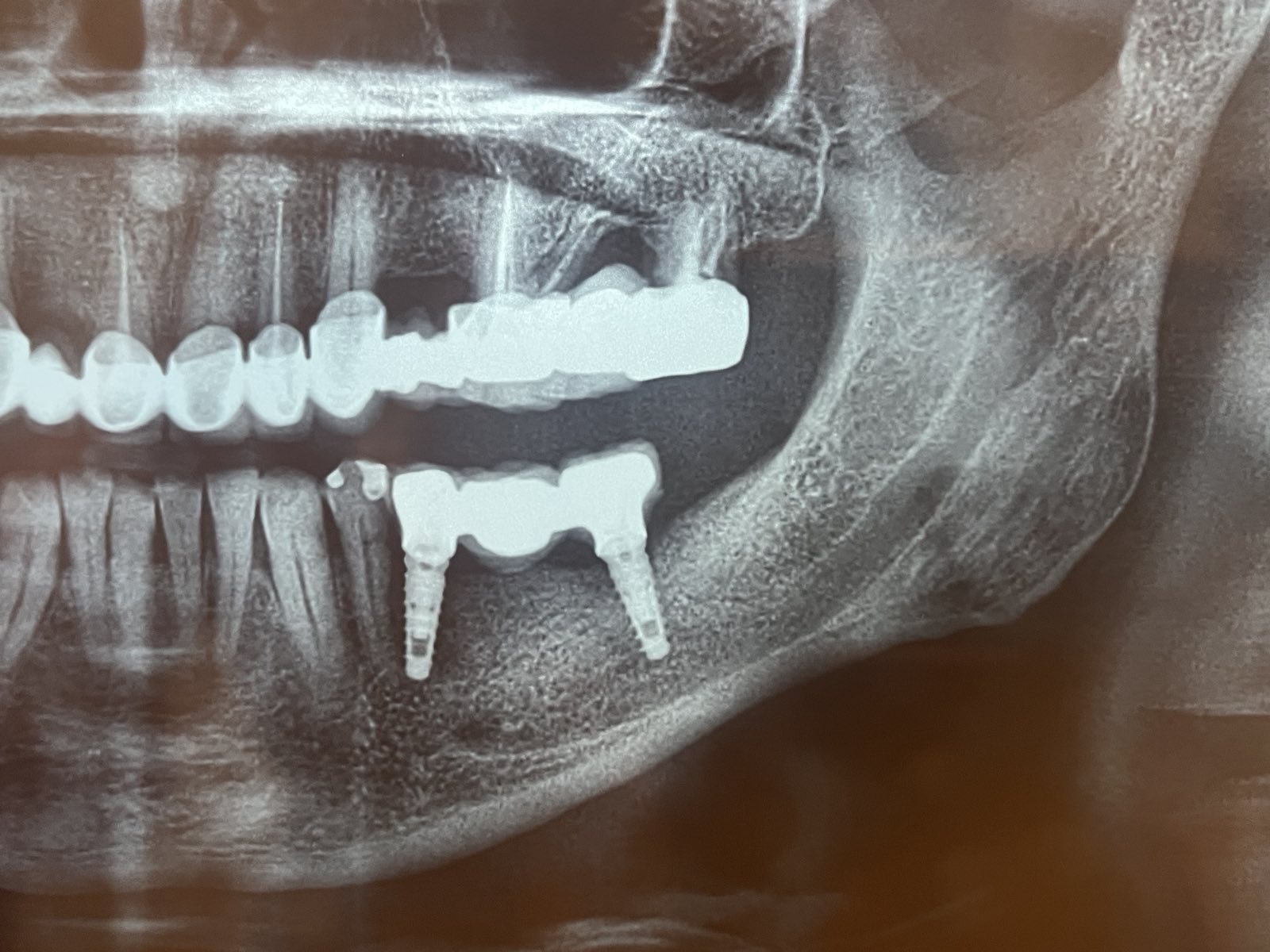
Placement of zeramex ceramic implants X-ray
The first step to a more joyful life
Dentures on implants are the most elegant and comfortable of all tooth replacement solutions. Implant-supported dentures fit perfectly and make you forget that you have artificial teeth in your mouth. No annoying palate plateau stands between you and your good taste in a nice meal. No “rebellious teeth” that get between you and the other person during a kiss or even fall out. You will also look in vain for visible metal parts like in conventional clasp dentures with implant-supported dentures. No one will believe that you are wearing dentures. With dental implants, you can speak, bite, eat, and kiss as easily as before you lost your teeth.
Which systems and procedures are ultimately used depends on your individual oral situation, your bone availability, and your budget.
Dental implants are very close to the natural model.
Dental implants are durable and more economical in the long term.
Dental implants prevent bone loss.
Your healthy teeth are not affected for dental implants.
Dental implants are permanently fixed – in every life situation.
Full dentures on implants do not require a palate plate.
Dental implants stay where natural teeth are: in the mouth.
Dental implants have no negative impact on pronunciation.
Dental implants keep your body healthy.
Dental implants are very close to the natural model
Like their “natural counterparts,” dental implants are firmly anchored in the jaw. From the outside, you won’t even be able to tell that you’re wearing dentures. Implants are not only “beautiful”; they also function like natural teeth – in the long term. Conventional dentures without implants initially fit very well if adjusted professionally. Unfortunately, bone loss can soon occur due to missing tooth roots. The result: The hold and, thus, the function of your dentures deteriorate inexorably. This causes problems with biting, chewing, speaking, and kissing and limits your social life. Who dares to laugh “heartily” when they are afraid that “the drawer” will fall out of their mouth?
Dental implants are durable and more economical in the long term.
According to studies, after ten years, 96% of all dental implants still sit securely in the jaw without any restrictions. If you consider that implant loss is often the result of inadequate dental care, the 3% implant loss is even partially avoidable. If you take proper care of your implants and come to the My Dent and Face dental practice clinic for regular dental check-ups, your implants can last your entire life. Conventional bridges have a much shorter survival time of 5 to 8 years. On the one hand, this is due to the bone loss that inevitably accompanies such solutions. On the other hand, they wear out more quickly. The faster wear is primarily due to the fact that stronger chewing forces act on the dental bridge and the jaw ridge due to the missing tooth roots. With natural teeth and implant-supported dentures, however, the chewing forces are passed on to the jawbone via the tooth roots. They have a positive effect because they stimulate jawbone growth and thus prevent bone loss.
Although dental implants initially require a higher financial investment, they are worth it long-term because they do not need to be replaced every few years.
Dental implants prevent bone loss.
If lost teeth are not replaced, this has a negative impact on chewing function. There is also a risk of bone loss in the area of the tooth gap. Even as the tooth socket heals after tooth loss, the bone loses volume. If countermeasures are not taken quickly, bone loss will continue unstoppably. The jawbone wants to be “trained” like muscles. The “dumbbells” of the jawbone are the natural chewing forces. As you bite and chew, the tooth roots constantly exert pressure and tensile forces on the bone. This stimulates the bone remodeling processes in which old bone is replaced by new. Where there is no tooth left, there is no chewing force and thus no stimulation. As a result, more bone is broken down than built up. At the end of such a process, all that remains in the area of the tooth gap is a heavily worn and narrow jaw ridge. If several teeth are missing in a row, bone loss is accelerated. The threat of bone loss can be stopped with dental implants because they replace the natural tooth roots and ensure the constant renewal of the jawbone.
Dental implants are permanently fixed – in every life situation.
You have probably already observed how older people try to use their tongues to push their loose-fitting “thirds” back “into place”. Such embarrassing situations can be avoided with dental implants. Speaking, biting, and chewing have become the most natural things in the world again. Implant-supported dentures are as natural to you as your natural teeth once were. With partial dentures, the clasps for attaching the remaining payment are visible in many situations. If a partial or full denture is not manufactured “masterfully”, you can immediately see from the denture base that it is made of plastic. Implant-supported individual crowns or dental bridges, on the other hand, appear very natural. The dental implants are deeply anchored in the jawbone. The connecting elements are also located below the gum line – invisible to others. With good “soft tissue management,” the color of the implant structures never shines through. For partial or full dentures based on implants, there is also a denture base made of plastic, but we can make this more delicate right from the start.
Full dentures on implants do not require a palate plate.
Conventional full dentures often spoil the joy of speaking and eating for their wearers. The plastic “palate plate” has a particularly negative impact on the sense of taste. Deep kisses are perceived as embarrassing because of the “plastic”. Securely fitting, implant-supported dental prostheses without a palate plate (depending on the number of implants) significantly increase wearing comfort and joy of life.
Dental implants stay where natural teeth are: in the mouth.
Dental implants are anchored in the bone, just like natural teeth. So, nothing changes when it comes to daily dental care. Conventional removable dentures are very easy to clean, but they have to be removed from the mouth. Sometimes, poorly fitting dentures fall out of your mouth on their own, not just in the bathroom but also in completely different situations. You are spared this embarrassment with implant-supported dentures.
Dental implants have no negative impact on pronunciation
If your conventional denture fits poorly, you are constantly trying to keep it on the ridge. This does not go unnoticed without affecting the pronunciation. The result is murmuring and lisping noises when speaking. This problem does not arise with dentures on implants.
- Talk and laugh without any problems
- Speak and laugh easily with fixed dental implants
Dental implants keep your body healthy.
A healthy diet is known to promote health. However, biting and chewing with poorly fitting dentures causes problems for many people. Dental implants, on the other hand, work just as well as natural teeth and help avoid an unbalanced diet. Food is also a part of the joy of life. It’s a shame when you have to deny yourself foods that you actually really like.
Dental implants FAQ
What are dental implants?
Dental implants are artificial tooth roots.
Dental implants are artificial tooth roots made of titanium or zirconium oxide ceramic, which are available in cylindrical or conical shapes. Many people also refer to dental implants as the entire implant construction. This consists of the implant body, structure (abutment, implant post), and prosthetic restoration (superstructure). The implant body replaces the missing tooth root and is not visible from the outside.
In addition to the three-piece dental implants, there are also one-piece implants, although these are rarely used for final dentures in the My Dent and Face dental clinic. In principle, three-part implants can be adapted much more flexibly to our patient’s individual requirements.
3-part structure of dental implants
Consists of three elements: implant body, abutment, and superstructure
In order for the implant structure and dental implant to “come together,” they are connected to each other using an abutment, a type of adapter. Standardized abutments made of titanium or ceramic are available to us in many variants for every purpose. We can also produce individual abutments for you using CAD/CAM. The artificial teeth are usually cemented onto the abutments, but screw-through connections are also conceivable.
1. Implant body (dental implant)
As an “artificial tooth root” that is firmly anchored in the jawbone using a cylindrical or conical thread, the implant body is the foundation of every dental implant.
The surface and the material used for the implant body significantly influence the course of the healing phase necessary after successful surgical implantation, in which the dental implant grows with the bone and the surrounding tissue. Since these are in direct contact with the body tissue, titanium is usually chosen as the base material for the production of dental implants, which not only impresses with its long durability and exceptional stability but also has a particularly high level of biocompatibility. Titanium implants can almost completely rule out Allergic reactions or intolerances.
However, due to their extreme hardness, dimensional stability, and similarity to natural tooth substance, ceramic implants made of zirconium dioxide represent an excellent, metal-free alternative that is particularly suitable for allergy sufferers or rheumatism patients, but in the majority of cases, they require a longer healing phase than titanium implants.
2. Implant structure (abutment)
An implant structure or “abutment” is a precisely fitting connecting piece that is connected to the implant body on one side and to the implant crown on the other side and – similar to an adapter – ensures a firm connection between the artificial tooth root and the denture. Like the implant body, abutments are usually made of titanium or ceramic.
There are several standardized options for fastening systems for implant-supported dental prostheses, such as ball head anchors, locators, bars, or telescopic crowns. Alternatively, CAD/CAM abutments made of titanium or zirconium oxide ceramic can be created for the patients of the My Dent and Face practice clinic, individually tailored to the respective anatomical conditions, which enable the soft tissue around the implant to be shaped particularly naturally and thus aesthetically.
3. Implant crown (superstructure)
Once the implant body has completely healed, the actually visible denture, the implant crown, can be attached to the abutment. This is usually done using medical cement or by simply screwing.
The visible part of the denture, the so-called superstructure, is usually made of metal (gold or titanium), all-ceramic, or a composite of both materials, in which a metallic crown is covered with a tooth-colored ceramic veneer. Visually, these “artificial teeth” can hardly be distinguished from their natural relatives, as they perfectly replicate the natural properties of a tooth down to the last detail.
If more than a single tooth is missing, several teeth or even entire rows of teeth can be replaced with implant-supported bridges or all-on-four or all-on-six solutions.
When and for whom are dental implants useful?
Implants are the right solution for many patients with existing and future tooth gaps.
Here are some examples:
- You are missing a tooth that you would like to have replaced from root to crown.
- You are at risk of losing your teeth because your tooth crown no longer holds in place and the tooth root is inflamed.
- You have already lost a lot of teeth, but you don’t want traditional dentures.
- You have lost several teeth but do not want to sacrifice healthy tooth structure to attach a dental bridge.
- You already wear a bridge or prosthesis. This fits loosely and causes sore spots.
- The constant use of adhesive creams is annoying for you.
- You want to prevent the jawbone from deteriorating due to the missing tooth roots.
- You would like to finally be able to eat everything again – even foods that require more chewing, such as apples or steaks.
- You want a better quality of life through better-fitting third teeth.
- You want back your old self-confidence that you lost because of your missing teeth.

Zeramex ceramic implants