
All-on-4 ® / All-on-6 ®
Beautiful, solid third teeth on just 4 or 6 implants in a single day, preferably without any previous bone build-up? The good news: thanks to the All-on-4 ® / All-on-6 ® treatment concept, the fulfillment of this dream is within reach. Fast, safe, and more cost-effective than most other implant restorations.
In a single treatment session.
We will remove your teeth that are no longer worth preserving if they are still present.
Insert the necessary four to six dental implants and immediately provide them with a functional, perfectly fitting temporary denture.
Both fixed and removable dentures are conceivable. The all-on-four / six method is based on state-of-the-art 3D X-ray diagnostics (DVT) and computer-based 3D implant planning in advance of treatment.
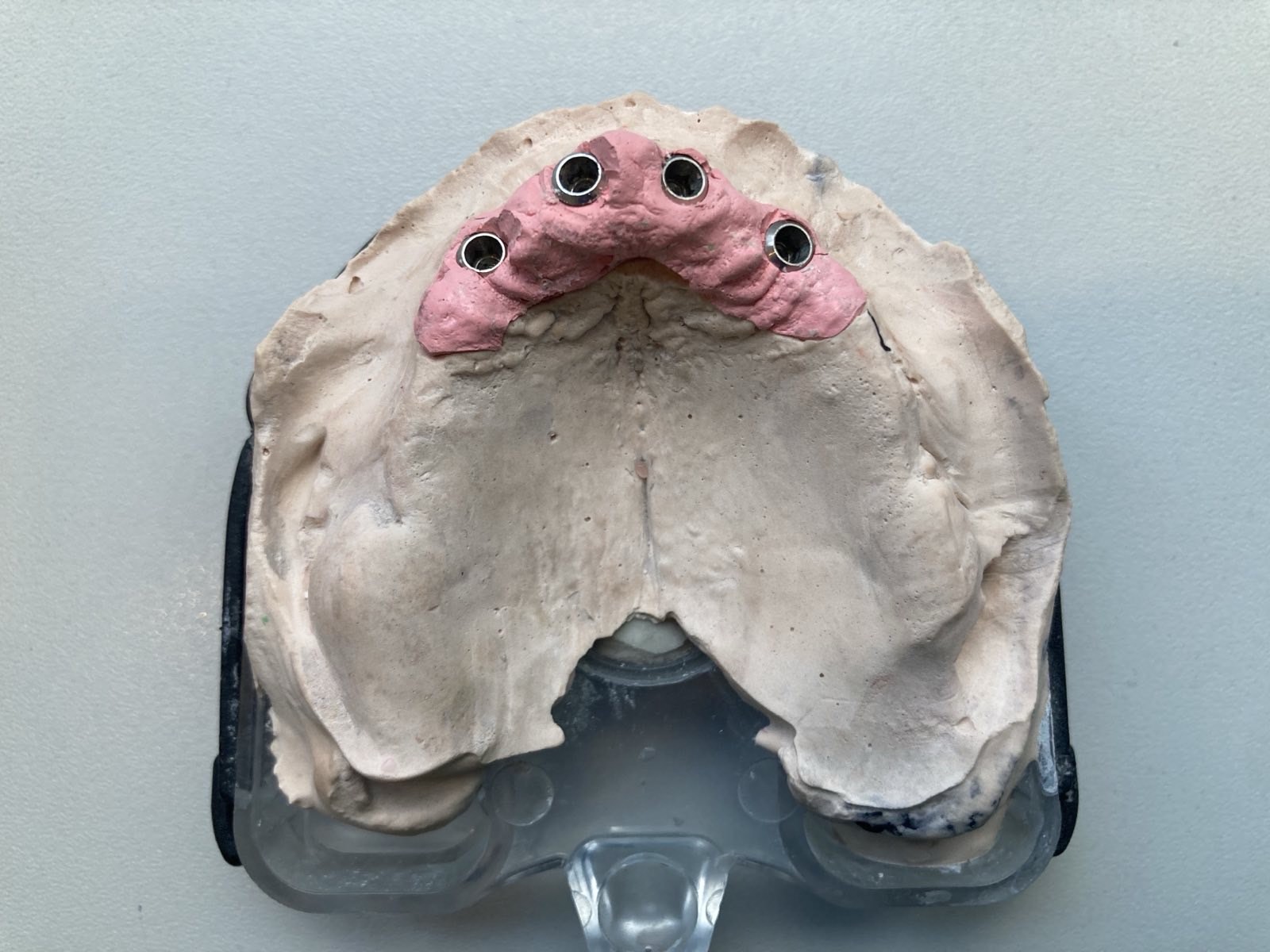
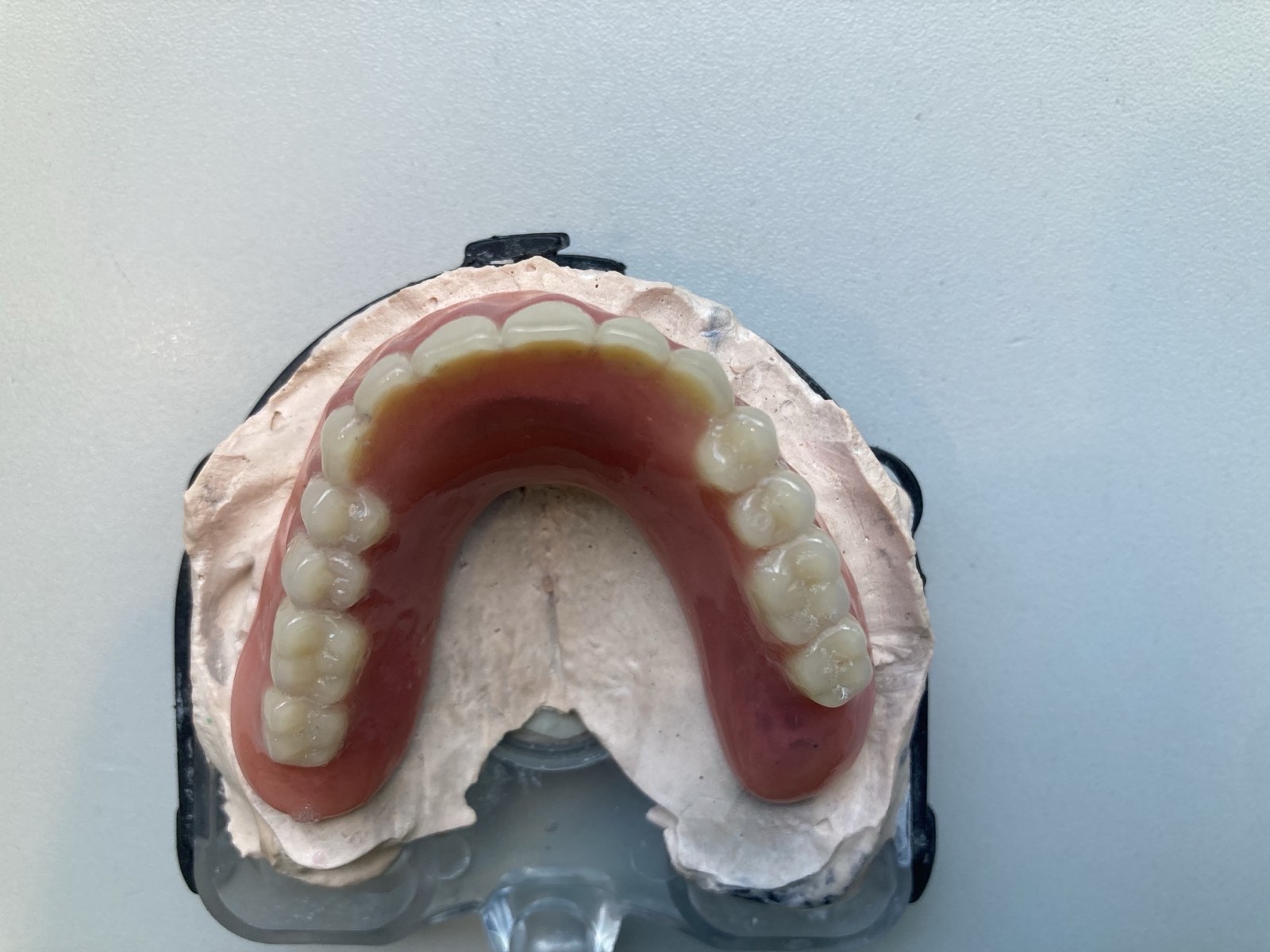
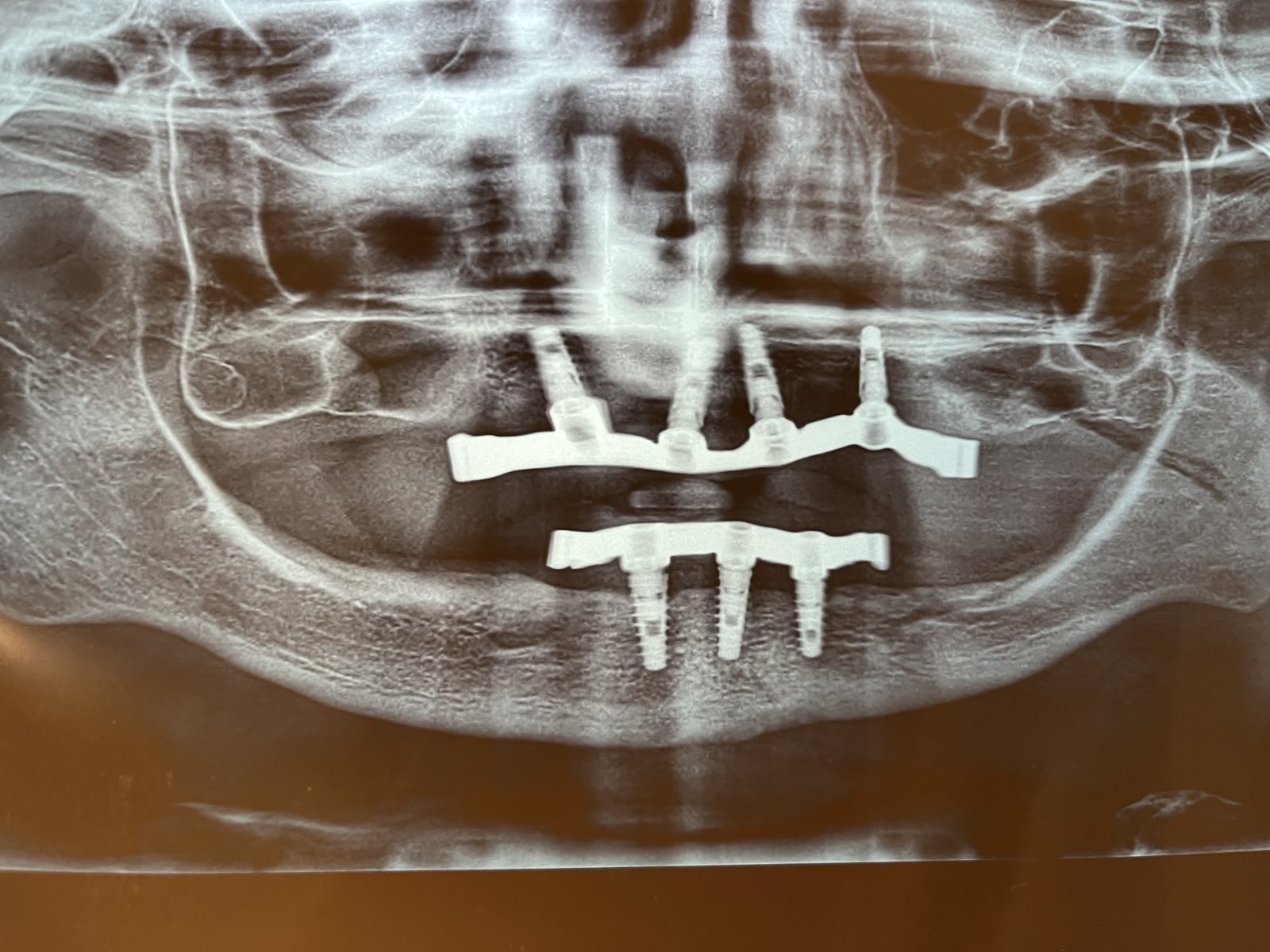
All-on-4 ® / All-on-6 ® – prosthesis on four implants with a lot of comfort
The All-on-4 ® / All-on-6 ® treatment concept is aimed at patients who have lost all or almost all of their teeth and want a fixed prosthesis with a lot of comfort. If you replace the missing teeth right from the start with All-on-4 dentures, the dreaded bone loss and the resulting poor fit of a full denture can be prevented.
Usually, no bone augmentation is necessary.
At the latest, when adhesive creams can no longer improve the fit of a prosthesis, many patients think about dental implants but shy away from the effort of building up bone.
Advantages
All-on-4 ® – the successful concept for the secure fixation of fixed dentures on just four implants – is ultra-modern, cost-efficient, and extremely quick to implement. But there are even more powerful arguments:
- Predictable results
- Overall, the significantly shorter treatment duration
- Ideally, only a single treatment session
- Usually, no bone augmentation is necessary
- Only 4-6 implants per dental arch
- Comfortable to wear
- More functional than conventional prostheses
- No plastic palate plate
- A natural sense of taste is retained
- Natural pronunciation is retained (no mumbling)
- Perfect fit
- Improved lip aesthetics
- Healthy-looking gums
- Protection of sensitive mouth and jaw structures
- 5-10-year success rate of almost 100%
The particular advantage of this method is that we do not postpone the implantation after the loss or extraction of your teeth but rather carry it out immediately. Dental implants replace natural tooth roots and help prevent bone loss. In addition, with an immediate implantation, we can shape the remaining surrounding soft tissue and preserve it in the long term.
Disadvantages
Three main aspects need to be taken into account with All-on-4® / All-on-6®:
- Complex treatment
- Interdisciplinary collaboration necessary
- Suitable for many patients, but not for every patient
- Complex treatment
The treatment preparation and treatment itself for the treating doctor are very complex. The treating surgeon’s knowledge and experience are the most important basic requirements for successful All-on-4® / All-on-6® care.
- Interdisciplinary collaboration necessary
Intensive coordination between the dentist and the dental laboratory is necessary to ensure the denture fits perfectly.
- Suitable for a large number of patients but not for every patient
All-on-4 ® / All-on-6 ® is suitable for almost all edentulous patients – even for patients who already suffer from jawbone recession. However, it may occasionally happen that we are unable to offer this method to a patient – for example, if the bone loss is particularly severe. Please also note that preserving your own teeth should always be a priority. Ultimately, this can only be done with a comprehensive preliminary examination at our My Dent and Face practice.
Treatment process – All-on-4 ® / All-on-6 ®
The All-on-4 ® / All-on-6 ® treatment at a glance:
- Initial consultation, classic examination, anamnesis
- Creation of a 3D X-ray (DVT) with subsequent 3D planning of the implant(s).
- Discussion of the findings and advice on treatment options
- Creation and discussion of a treatment and cost plan
If necessary, further consultation in which we will inform you about the entire treatment process:
- The procedure of the surgical procedure (surgical information)
- Treatment after surgery (post-operative phase)
- Process of the actual prosthetic restoration.
- Aftercare measures
- The implant surgery/procedure: computer-guided implantation using a drilling template and provision of temporary dentures
- After approx. 10 days: next check-up appointment and removal of the stitches
- After approx. 4-6 months: Impression of the jaw to create your final dentures
- Approximately 7-10 days later: Try on your final dentures
- The final, final prosthetic treatment usually takes place after 3 to 4 months
- Twice a year: check-up and – if necessary – preventive measures to maintain the success of the treatment (e.g. professional implant cleaning)
- Every 1 – 2 years: new x-rays
Removable prosthetic construction of 4 implants on the upper jaw and two implants on the lower jaw connected to the traverse in patients without teeth – the advantage is that the patient can clean the implants well by removing the construction for cleaning. This is a significant indicator of the long-term prognosis of the implants.
All-on-4 ® / All-on-6 ® – FAQ
When are dental implants inserted, and when can they be loaded?
We would like to provide the terms here to anyone who is interested.
- Immediate implantation
- Delayed immediate implantation
- Late implantation
- Immediate care
- Immediate loading and primary stability
- To make the All-on-4 ® / All-on-6 ® treatment concept a little more understandable
Immediate implantation
The term immediate implantation means that we insert dental implants into the resulting tooth sockets (alveoli) immediately after removing your teeth that are no longer worth preserving. An immediate implantation describes the best time for inserting a dental implant, even in the case of inflammatory tissue changes, which is why this method is used in the My Dent and Face practice – whenever possible.
Delayed immediate implantation
We speak of delayed immediate implantation if the implant is not inserted at the same time as the tooth is removed but before the tooth socket has healed and possibly even before the soft tissue has healed.
Late implantation
Late implantation corresponds to the classic implant insertion after the bone socket has completely healed, which takes around six weeks to several months.
Why (delayed) immediate implantation?
Immediate implants help to avoid the accelerated bone loss caused by toothlessness, which is a significant advantage over delayed implants. In addition, (delayed) immediate implantation shortens the overall treatment time.
A disadvantage compared to late implants is that there is a risk of implant loss if there is residual inflammation. However, with an experienced implantology expert, this disadvantage almost never comes into play.
Immediate care
If a dental implant is provided with a temporary dental crown immediately after insertion, we speak of “immediate restoration”. As a rule, the immediate restoration may only be subjected to moderate loading until the implant has completely healed. Therefore, the temporary restorations are made into a specific shape in order to reduce the chewing pressure on the implants while the implants heal.
Immediate loading and primary stability
Immediate loading of freshly inserted implants is possible if we connect them to a crown block – as with All-on-4® / All-on-6®. In this way, the chewing forces are distributed over several implants, and the individual implant is not put under too much strain. It is important that the dental implants sit securely in the bone before healing begins, i.e. have a high level of “primary stability”. Implants for immediate implantation have a special geometry to ensure primary stability.
Basic requirements for All-on-4® / All-on-6®
The good news: We can make this possible for almost all patients who would like All-on-4®/All-on-6® care. There are only a few basic requirements:
- The jaw is toothless or almost toothless
- Any teeth that may still be present are no longer worth preserving
- Our patients are willing to have a detailed anamnesis and consultation with us
- The amount of bone available in the area of the front teeth is sufficient (in the area of the posterior teeth, a reduced amount of bone is usually not an obstacle)
- All on 4 / 6: The supply options
With the All on four / six method, a fixed or removable prosthesis can be attached to the four or six implants. There are various supply options available. The selection of the appropriate method depends on your bone supply and your budget. We would be happy to advise you on this.
All on four with a prosthesis on a bar restoration
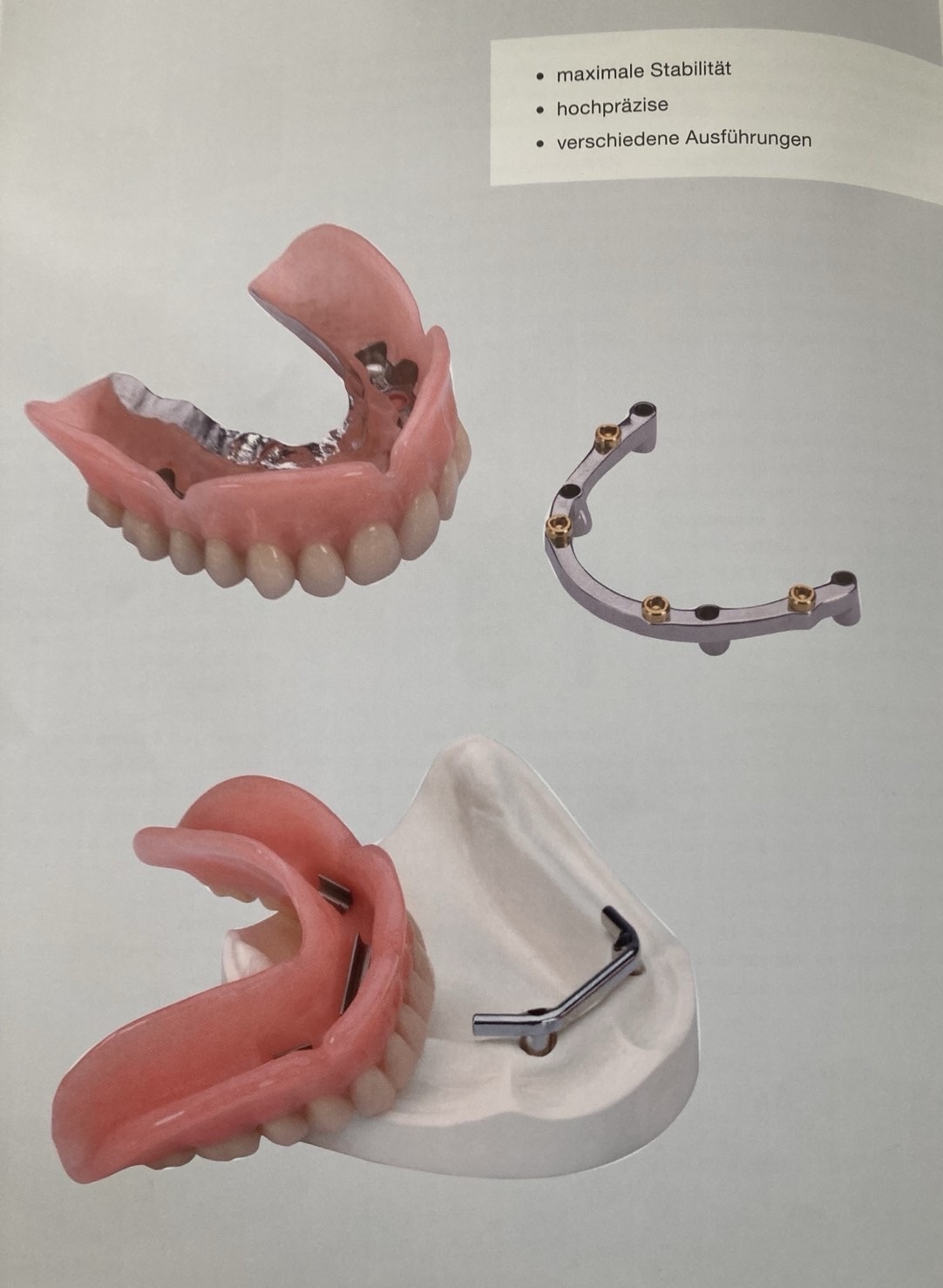
Alternatively, removable prostheses can be anchored on a bar. For this purpose, the four Comfour implants are blocked with a bar. The counterparts of the bars are the “bar riders” incorporated into the prosthesis, which snap onto the bars of the implants when the dental prosthesis is inserted. The bars create a very strong blocking of the dental implants so that they can be loaded immediately. Dentures on bars can be useful if the bone conditions are poor.
All on four with a screwed bridge (Malo concept)
If dental implants of sufficient length/size can be implanted in the jaw, it is possible to screw the four implants into a fixed bridge.
All on six with a screwed bridge
If the conditions are met to distribute six implants over the jaw, a fixed bridge can also be firmly anchored. All on six is often used in the upper jaw because the bone supply there is often no longer as good as in the lower jaw.