Tooth extraction
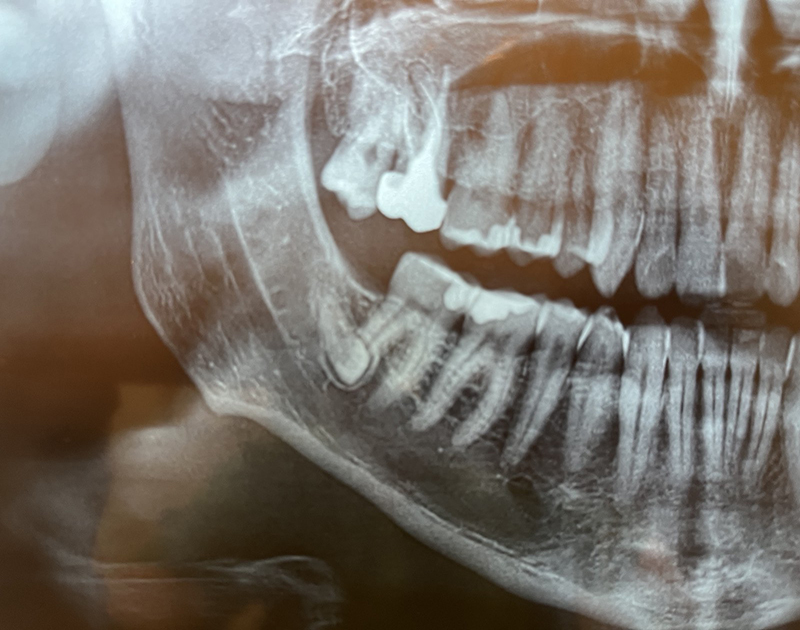
The dentist does everything he can to save defective or diseased teeth through tooth-preserving measures such as root canal treatment, parontitis treatment or, if necessary, a root tip resection. Sometimes the teeth are so damaged that this is no longer possible. Then again, teeth can become a disruptive factor due to their position in the jaw (displaced teeth). In both cases, tooth removal may be necessary. We basically differentiate between conventional and surgical tooth removal.
Conventional tooth extraction
If a tooth needs to be removed, the dentist will first use special instruments to loosen the tooth to be removed after anesthesia and then remove it. The bone is then cleaned, and the wound’s edges are pressed together. The patient bites on a gauze swab, allowing a blood clot to form. If the initial conditions are more complex or there is more bleeding, the mucous membrane above the empty tooth socket is sewn shut. The stitches are usually removed a week later. The wound healed within just a few weeks. At this point, it makes sense to think about replacing the lost tooth with a dental implant. A dental implant prevents the bone from breaking down prematurely where the empty tooth socket is. We would be happy to advise you on this.
In which cases the surgical tooth removal is particularly necessary?
Tooth removal requires opening the mucous membrane and possibly removing bone tissue. These are often wisdom or other teeth that have not or only partially made their way to the surface.
Tooth removal is complicated due to its unusual position. This is often the case with wisdom teeth that are crooked in the jaw.
Typical process of surgical tooth removal
The mucous membrane over the affected area is gently opened and folded to the side for surgical tooth removal. If necessary, the oral surgeon carefully removes the bone above the tooth. In the My Dent and Face practice, we use ultrasound-based piezosurgery procedures that are exceptionally gentle on the tissue. After exposure, the teeth or parts of the teeth are removed. The mucous membrane above the wound is then folded back and sutured. Painkillers and regular cooling help very well against any pain and swelling that may arise. We will, of course, explain precisely what you should pay attention to after the dental operation.
Gentler and safer tooth removal through 3D planning
The essential requirement for a gentle dental operation is a thorough diagnosis before the tooth extraction. If the teeth are very crooked or lie very deep in the jawbone, DVT X-rays are almost essential before the dental operation. The three-dimensional images perfectly depict the exact position of the teeth and the surrounding structures. This enables precise treatment planning and surgery that is particularly gentle on the tissue, and healing occurs more quickly.
The removal of wisdom teeth takes up a lot of space in the area of surgical tooth removal.
Partial toothlessness also has consequences
Even if only a few teeth are missing, this should not be trivialized because the set of teeth should always be viewed as an overall complex – if one or more links in the chain are missing, this always leads to changes that affect the entire organism. The effects of this form of toothlessness can vary in severity and affect various areas of the body – depending on which and how many teeth you are missing. In our dental practice, My Dent and Face, we can correct your partial toothlessness quickly and effectively using the best method for you.