Bone augmentation
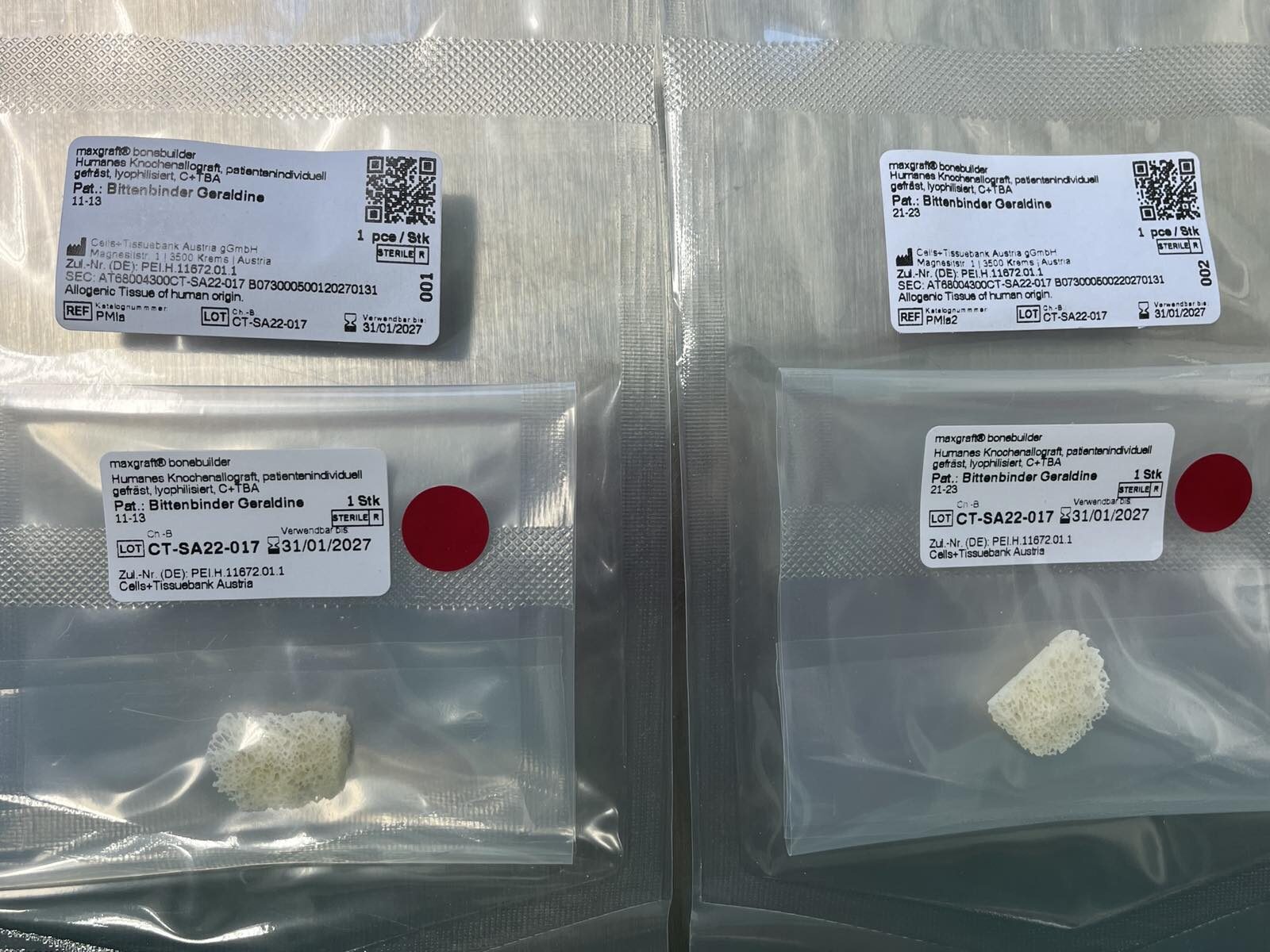

Bone blocks (3d printed bones).
Bone augmentation is a surgical procedure after bone loss that can be used to create a solid bone base for dental implants.
Bone reconstruction requires a great deal of expertise and experience.
Means and methods for building jawbone
If our 3D implant planning shows that an implant is not surrounded by at least 5 mm of bone at the planned position, the possibility of inserting the implant into the bone at an angle of up to 45° can be examined. This allows for better bone attachment of the dental implant. Only if this is not possible will bone reconstruction be necessary.
What means is used to build bone in the upper or lower jaw?
Which of the bone-building methods listed below we ultimately choose depends on the remaining bone available and the initial situation of the jaw.
Bone attachment
Bone apposition is a bone-building method that we use primarily for smaller bone defects. Bone meal or bone chips are used as construction materials. These are obtained through the drilling process or taken from the immediate vicinity of the surgical area. Autologous bone contains vital cells that are necessary for the growth of new bone. With this method, the bone grafting material is attached directly to the bone defect.
The area where the bone was deposited is covered with a special collagen membrane. The collagen layer forms the necessary barrier between the bone and the overlying mucosal layer during the healing period. Mucosal cells grow faster than bone cells. By separating the two areas, the mucous membrane cells are prevented from colonizing the bone cells, thus jeopardizing the success of bone formation. The collagen membrane, which is also used in other bone-building methods, is completely broken down by the body.
Advantages of bone attachment
- Safe method
- Very gentle (no surgical removal of your own bone necessary)
- The bone-widening
- Bone spreading and bone splitting
Bone spreading and bone splitting are used to widen an alveolar ridge, i.e., the tooth-bearing part of the jawbone (alveolar ridge), that is too narrow. The surgical stretching or splitting of the jawbone is also called “osteotomy”.
Bone spreading
In so-called bone spreading, the bone is gently pushed apart using certain instruments, and the resulting space is filled with bone replacement material. Bone spreading is only suitable for the soft upper jaw bone.
Bone splitting
The difference between bone splitting and bone spreading is that the bone is not spread before the bone material is introduced but is split very carefully.
Depending on the requirements, the dental implant can be inserted either at the same time as the bone is built up or after a healing phase of several months.
Advantages of bone spreading/bone splitting
- Gentle procedure
- Good blood circulation in the cleft space
- Possibility to insert implants immediately
The bone block method/ Bone block transplant
The bone block method can be used for larger bone defects or severe bone loss. During bone block transplantation using your own bone, bone blocks are taken from the jaw, chin, or (less commonly) the hip bone and added to the bone area to be built up. The body’s own bone block is attached using small screws. After about three months of healing, the screws can be removed and the implants inserted. Any smaller bone defects that may still exist can be repaired during the implantation using the conventional bone apposition process.
The botiss bonebuilder® technology is a particularly innovative form of bone block transplantation. It is used in both the upper and lower jaw. This bone-building method is particularly suitable for three-dimensional bone defects, i.e., in cases where the bone is both too narrow and too low. The special thing about the botiss® bone block is its highly individual shape.
The basis for providing the individual bone block is the “botiss bonebuilder® & materialize SimPlant® technology”. Based on three-dimensional DVT images and with the help of the 3D planning software Simplant, the necessary piece of bone is first designed on the computer. The planning data is then converted into a so-called “milling file” and sent to the manufacturer. He uses the data to create an individual bone block and sends it in sterile packaging.
The advantages of botiss bonebuilder® technology
- The perfect fit of the individual bone block
- No further adjustment is necessary
- Economical and significantly shorter treatment time
- Particularly gentle (minimally invasive), as no bone removal is necessary
- This results in even better contact between the transplant and your own bone
- Improved vascular formation
Distraction osteogenesis
Distraction osteogenesis (also called callus distraction) is a bone-building procedure that is used extremely rarely. It is used when the bone height is too low or to lengthen the bone.
With this method of bone augmentation, the oral surgeon cuts through the bone area to be treated horizontally. Using a distraction device (Latin: distrahere = to pull apart), the two fragments lying on top of each other are pulled apart by up to 1 mm daily until the desired bone height is reached. New bone (callus) can gradually form in the space created in this way. The distraction device is only removed when the newly formed bone has sufficiently strengthened. The entire process of bone augmentation with distraction osteogenesis takes three to four months. After this time, the bone is strong enough to support implants.
The advantages of distraction osteogenesis
- Almost painless
- Gentle procedure (no bone removal necessary)
- High success rate
- Soft tissue is stretched
- No additional interventions in the soft tissue are necessary
- Aesthetic shaping of the soft tissue in the area of the later implants is possible