Cyst removal on tooth, gum, jaw

Cyst removal

Large bone defect after cyst removal.
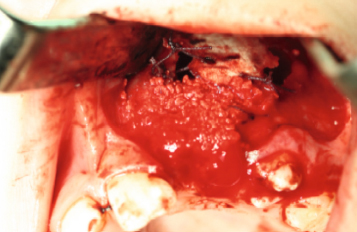
Mixing the bone substitute material with the blood and placing it in the defect.

Panoramic photo, 6 months after the operation, showing a perfect balance between the bone substitute material and the own bone.
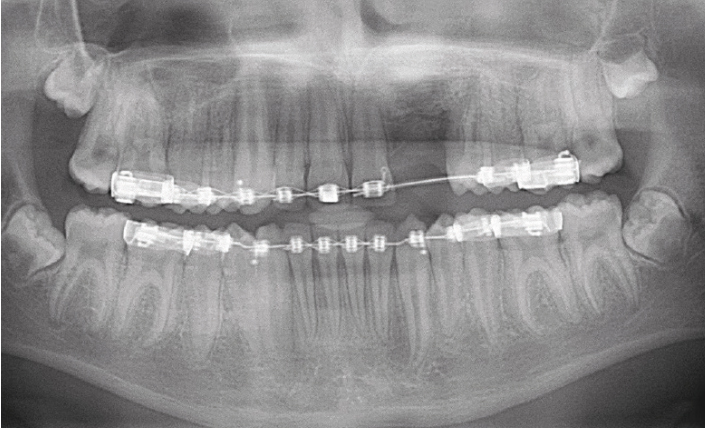
Panoramic photo after 6 years showing a solid bone base for implant placement.
Photos are taken from the article Follicular cyst treatment using Cerasorb M bone substitute material (in German) from Priv. Doz. Dr. Dr. Arwed Ludwig.
Jaw cyst removal or “cystectomy” is an important branch of oral surgery. In addition to removing the cyst, the goals of treatment are:
- The prevention of tooth displacement, tooth loosening, and tooth loss
- The preservation or restoration of normal oral structures
- The formation of new bone in the defect
- Relief from any existing pain
- The restoration of normal biting and chewing ability
Sometimes the removal of a jaw cyst also creates the necessary conditions to provide a jaw with dental implants or alternative dentures.
Removal of cysts in My Dent and Face: almost painless thanks to piezo surgery
Many people are afraid of pain when undergoing oral surgery. Modern surgical methods are so gentle that this concern is completely unfounded. The My Dent and Face practice, dentists specializing in oral surgery and implantology, operates using piezo surgery wherever possible. Piezo surgery is an innovative, ultrasound-based procedure that can be used to cut and remove bone, particularly gently. The big advantage of this method is that it acts selectively on the bone but protects the surrounding soft tissue, nerves, and blood vessels.
In the following paragraphs, you will find answers to your most important questions about the complex topic of cysts (jaw cysts, oral cysts, mouth cysts). We will also discuss types of cysts that are very rare but should be mentioned for the sake of completeness.
If your questions are unanswered here or you want comprehensive advice, make an appointment at the My Dent and Face Varna practice. The friendly and relaxed dental team will be happy to advise you.
What is a jaw cyst (cyst)?
Jaw cysts can occur in the gums of both the upper and lower jaw. These are usually cavities in the bone that are surrounded by a membrane (epithelium). They are filled with a thin or viscous liquid.
The fluid contained in a cyst is usually sterile, but it can also become infected and produce pus. If a cyst becomes infected, it is also called an abscess. Since the fluid in the cyst cannot drain away, it grows larger over time and puts pressure on the surrounding bone, causing it and the surrounding tissue to gradually break down. Since jaw cysts only cause noticeable problems when they reach a certain size, they are usually discovered accidentally on an X-ray. However, when cysts become infected, pain and swelling occur quite quickly, no matter how large they are.
Why do cysts arise (jaw cysts, oral cysts)?
Most jaw cysts are caused by bacteria that penetrate from the root canals of dead teeth into the surrounding bone and cause an inflammatory reaction there. Even after root canal treatment, bacteria can remain in the root canal if the root filling was carried out too late or incompletely.
Another reason for the formation of cysts is developmental disorders. Genetic cysts such as those in the so-called Gorlin syndrome are also possible but very rare.
Where can jaw cysts occur?
Cysts (jaw cysts) can occur in the upper and lower jaw bones or as oral cysts in all other oral tissues, including:
- Gums
- Lip, cheek, and mouth mucosa
- Tooth roots
- Tongue
- Throat
- Salivary glands
What type of cysts are there?
- Odontogenic cysts (arising from the teeth)
- Non-odontogenic cysts
- Pseudocysts
In principle, pseudocysts are also non-odontogenic cysts. They differ from real cysts in that their interior is not surrounded by an epithelial layer but only a layer of connective tissue.
Odontogenic cysts
Odontogenic cysts make up the majority of cysts found in the jaw. They arise from tissue in the dental system and usually only cause problems when they reach a certain size. As they grow larger, they sometimes become noticeable as a small bulge. If left untreated, odontogenic cysts can continue to grow, displace the jawbone, and cause tooth damage. The odontogenic jaw cysts originating from the teeth can have inflammatory and developmental causes. If an odontogenic cyst becomes inflamed, it can cause severe pain. In the worst-case scenario, the infection can spread to other body areas.
Odontogenic cysts include:
- The follicular cyst
- The residual cyst)
- The dentition or eruption cyst (breakthrough cyst)
- The keratocyst
- The periodontal cyst
- The gingival cyst in children and adults
- The glandular cyst
- The lateral periodontal cyst, as well
- Radicular cysts – dental root cysts
1. Radicular cysts – dental root cysts
Cysts in the area under the tooth root, called radicular cysts, are the most common. Its formation is caused by inflammation at the root tip of already dead teeth. The inflammatory-related radicular jaw cysts develop particularly frequently in the upper jaw.
2. Follicular cysts – originating from the dental sacs
Follicular jaw cysts are the second most common. Dental development disorders cause them and originate from the tooth sacs (tooth follicles) surrounding each tooth during its development. They are found in the crown area of impacted (not erupted) or partially impacted (partially erupted) teeth. The upper canines, lower wisdom teeth, or supernumerary teeth are particularly affected.
3. Residual cyst – cysts left in the jawbone
Residual cysts are radicular or follicular cysts that remain in the jaw after the affected teeth have been extracted and continue to grow.
4. Dentition cysts (eruption cysts, eruption cysts) – on milk teeth
A dentition or eruption cyst can form over a milk tooth that has not yet erupted, starting from the tooth sac. This type of cyst is noticeable as a bulging mucous membrane over the baby tooth. Eruption cysts often cause problems during teething but are usually ruptured when the teeth emerge. As a rule, the oral surgery dentist does not have to do anything here unless the process is accompanied by inflammation or pain.
5. Keratocyst (primordial cyst) – originating from the tooth bud
The development-related, rapidly growing keratocyst does not arise from the existing tooth system but from the tooth bud (tooth system). However, it can sometimes also be found on teeth that have not erupted or have only partially erupted. The rare keratocysts are more common in the upper jaw than in the lower jaw.
The keratocyst is not actually a cyst but rather a rapidly growing, benign tumor that quickly displaces the surrounding tissue. Accordingly, today we correctly speak of a “keratocystic odontogenic tumor” instead of a cyst. The word “Kerato” means cornea and refers to the fact that this type of “cyst” tends to keratinize.
Keratocysts can be a side effect of the so-called “Gorlin-Goltz syndrome”, a genetic disease that is accompanied by brain and skeletal malformations as well as certain skin tumors (skin basal cell carcinomas).
6. Periodontal cyst – next to the teeth at the neck of the teeth
A periodontal cyst forms at the level of the neck of the tooth next to the teeth. Periodontal cysts arise due to tooth pocket inflammation, which in turn is caused by bacterial plaque.
7. Gingival cyst – nodules on the gums
Gingival cysts often form on the lower canines and anterior-posterior teeth. They appear as small, bluish, shimmering nodules. They arise from tissue that is responsible for the formation of tooth enamel.
In children, the differentiation is referred to as infantile gingival cysts. Similar to breakthrough cysts, these usually do not need to be treated.
8. Glandular odontogenic cyst – mucosal cyst
Glandular odontogenic cysts (GOZ) usually occur between the ages of 45 and 50, preferably in the lower jaw. They arise from the mucous membrane of the jaw ridges, i.e., the tooth-bearing part of the jawbone. These very rare cysts require urgent treatment as they can cause severe damage to the bone.
9. Lateral periodontal cyst / Interradicular cyst – between two tooth roots
Lateral periodontal cysts form within the jawbone between two vital teeth. They, therefore, differ from radicular cysts, which form around the root tips of dead teeth.
Non-odontogenic jaw cysts
Non-odontogenic jaw cysts
Non-odontogenic cysts do not arise from the dental system but from other oral structures. Sometimes, they are a direct result of developmental disorders of the jaw and/or skull. Non-odontogenic cysts include:
- The mucous cyst (mucocele)
- The floor of the mouth cyst (ranula or frog tumor)
- The gingival cyst (epulis, local fibrous hyperplasia)
- The nasopalatal cyst
- The nasolabial (nasoalveolar) cyst as well as the
- The pseudocysts
- Mucous cyst (mucocele)
1. Mucous cyst (mucocele)
The mucous cyst (mucocele, mucoid cyst, mucous gland cyst, retention cyst) is so named because it is filled with mucus. It occurs when the glands that produce the mucous membrane are blocked. Mucoceles, which also include the floor of the mouth cyst, are always completely removed.
2. Floor of the mouth cyst (ranula)
The floor of the mouth cyst lies below the tongue and arises when the sublingual gland (major sublingual gland) is “clogged”. Accordingly, the floor of the mouth cyst or ranula is filled with thick mucus. It becomes noticeable as a turgid and elastic swelling that can be felt and moved easily.
3. Gingival cyst (epulis, local fibrous hyperplasia)
An epulis (Greek for “growing on the gums”) usually sits on the gum line and is shaped like a hemisphere or mushroom. Possible causes of their development are inflammation that comes from the gum pockets but also mechanical stimuli from filling edges, crowns, or dental prostheses. The epulis and tooth are often removed at the same time.
4. Nasopalatal cyst
Nasopalatal cysts almost always arise right in the middle of the palate. They are formed from tissue remnants left over from the time of jaw and skull development.
5.Nasolabial (nasoalveolar) cyst
The same applies to the nasolabial cyst as to the nasopalatal cyst. It develops between the palate and nose.
6. Pseudocyst
A pseudocyst is characterized by the fact that its connective tissue capsule – unlike real cysts – is not lined with an epithelium. Pseudocysts often do not cause any symptoms and cannot always be removed. Bone cysts, in particular, fall into the “pseudocyst” category.
7. Simple (juvenile) bone cyst
Simple (juvenile) bone cysts are often painful single-chamber cysts that can lead to hypersensitivity of the teeth. The causes for their formation are not known. Simple bone cysts are often found in the lower jaw of the juvenile dentition.
8. Aneurysmal bone cyst
The formation of multi-chambered aneurysmal bone cysts that occur in adults is also not known. It is characterized by very rapid growth and quite often leads to teeth tipping.
How can you recognize jaw cysts/cysts?
Non-inflamed cysts at a certain stage do not show any symptoms or cause pain. They are often discovered by chance on an X-ray, where they appear as clearly defined, rounded structures. Cysts contain a thin or viscous fluid inside. Since this fluid cannot escape, the cyst continues to grow. Only when it has reached a certain size and begins to press on neighboring teeth and nerves does a jaw cyst cause pain.
Cysts become inflamed, can swell very quickly, and then cause very severe pain.
When do you have to operate/remove cysts?
Cysts are usually only removed by an oral surgeon when they become significantly larger and displace the surrounding tissue. This is usually noticeable through a feeling of pressure and pain. Once discovered, it is very important to monitor a cyst. This is the only way the dentist can intervene in a timely manner, and this is the only way secondary diseases can be ruled out. Observation is carried out through regular radiological checks.
Which diseases can cause cysts?
As jaw cysts continue to enlarge, they displace an ever-increasing portion of healthy tissue. If a cyst is not removed in a timely manner, the following complications and diseases can occur:
- Tilting of teeth
- Loosening of teeth
- Tooth loss
- Deformation of the jawbone
- Broken jaw
- Nerve damage